

If you have a question about Sha'alvim's Overseas Students Program, or would just like to find out more about the program, here are some of the answers to our most frequently asked questions
What is the affiliation/hashkafa of the Yeshiva?
Sha’alvim aims to provide its students with a high level of learning, instilling in them a love for, and commitment to, Torah, Klal Yisrael, and Eretz Yisrael. The ideal Sha’alvim student is a lamdan, yarei shamayim, and ba’al middot. As a Hesder Yeshiva, we present a positive attitude toward Eretz Yisrael and Medinat Yisrael with stimulating Yom Ha’atzmaut and Yom Yerushalayim tefilot, chagigot, and tiyulim. Students are encouraged to continue their Torah and university studies in a setting conducive to mitzvot, yirat shamayaim, and ahavat Yisrael. Students regularly participate in chesed programs during the breaks.
What kind of relationship do the students have with the Rabbeim?
The students and the Rabbeim share a warm relationship. Many of the Rabbeim live on campus, and their homes are open to their talmidim at all hours. The students see their Rebbe as a spiritual guide as well as teacher, and often confide in and consult with their Rebbe about life's questions and problems. Many students continue this relationship for long years after they depart Sha'alvim, and not infrequently has a first year Rebbe also had the pleasure and honor of also being a Mesader Kidushin years later.
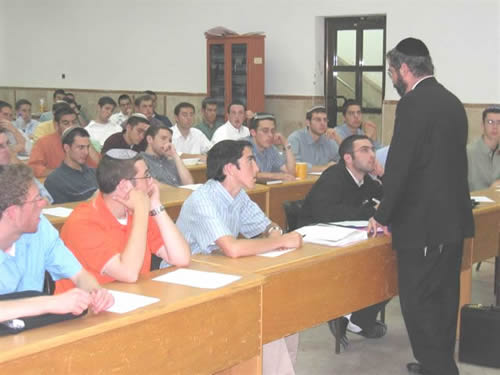
The Iyun Gemara shiurim are taught at an advanced level, in Hebrew, and require a prior background in learning, such as that given in a Yeshiva High School . The first year shiurim are given by Rav Dovid Lebor and Rav Eliyahu Reich. The second year shiruim are given by the Rosh HaYeshiva Rav Yechezkel Yakovson and by Rav Yosef Nusbacher. Each Magid Shiur has his own style, but in general, emphasis is placed on acquiring a derech in limud, and mastering the skills needed to learn in depth and independently.
The other shiurim/chugim are given in both Hebrew and English by various faculty members and kollel members, as well as expert guest lecturers who come specially to Sha'alvim to teach courses for the overseas students.
Three meals a day are served in the cafeteria. Breakfast and Dinner are Milchig, and Lunch is Fleishig. The food is primarily an Israeli cuisine, and differs from a traditional American meal. Most of the students adjust to the different food quickly and enjoy it. Those students who have trouble getting used to the food can purchase whatever they like at the Makolet (located on campus), and prepare whatever they like to the best of their ability. The Makolet is open every day from 8:00AM to about 8:30PM
Each room houses three or four students. They are not overly large or overly small. The rooms are each equipped with a private bathroom with a shower. There is one writing table in each room which is shared by all of the roommates. It is the responsibility of the students to keep their own rooms neat and clean.
Laundry is done for the students in the modern laundry facility found underneath the cafeteria. Students drop off their dirty laundry once a week, and pick it up cleaned and pressed a few days later. If something needs to be dry cleaned, the student must care for it himself. There are numerous dry cleaners available in Yerushalayim.
How far is it to Yerushalayim?
Not close enough to distract students from learning, but easily accessible when the need arises. The drive to Yerushalayim from Sha'alvim takes 30 minutes. Depending on the time of day, one can either get a ride in with one of the many people leaving Greater Sha'alvim, or can take a bus. When a number of students are traveling together, they often hire a cab, which, per person, is not much more expensive than the bus.
 What's the relationship between
the Israelis
and the Americans?
What's the relationship between
the Israelis
and the Americans?
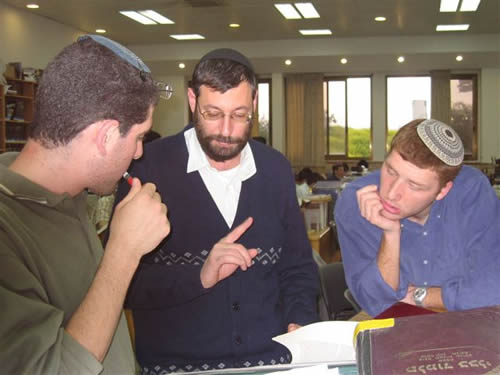
The Israelis and the Americans learn together in the same Beit Midrash, go to many of the same Sichot, and share the same cafeteria and dorms. The Iyun Shirim and the Chugim are separate. Most of the overseas students cite their desire to be part of an Israeli Yeshiva as one of the reasons they came to Sha'alvim, and many develop close relationships with the Israeli students, and often have Israeli Chavrutot.
What do the guys do when they're not learning?
There are many activities organized by Sha'alvim for the overseas students outside of the regular studies (see next question). Additionally, students spend their time playing sports and exercising, talking to friends and writing home. Most have email, which seems to take up a lot of their free time each morning.
Are there any organized activities besides learning?
Yes. There are many Tiyulim and Shabbatonim scheduled throughout the year. These trips are planned both for their educational value, and with the intent that students enjoy themselves and come to learn about and appreciate Eretz Yisrael. Many students also participate in annual Yeshiva missions to Poland .
Email accounts are provided free of charge.
How do I know if Sha'alvim is right for me?
Read this FAQ, browse the rest of the site, and then most importantly, talk to some of our former students who know you, and who can help you decide if Sha'alvim offers a program that suits your needs, and if you're ready for what Sha'alvim offers. If you have any further questions please feel free to contact our U.S. representative, Aryeh Leibowitz at Ajleibow@yu.edu.
If you are attending a Yeshiva High School , talk to your principle or Rebbe. They know what to do. Otherwise, you can contact us directly at Shaalvim@Shaalvim.co.il or at the U.S. office Office@USshaalvim.org and let us know you are interested in finding out about the application process.